Architecture
GRANDstack is a way to build apps on a Neo4j graph with GraphQL: a Neo4j database, a GraphQL server generated from a schema file, and a React client with typed operations. The A now stands for Agent: the same GraphQL API that serves the web app is meant to serve coding agents and agentic apps too. Apollo has been removed; the pieces are Neo4j’s GraphQL library, GraphQL Yoga and open-source libraries that run locally in Docker.
This guide describes what is built today (the versions that were tested together are in versioning and releases). What is planned is on the roadmap.
Components
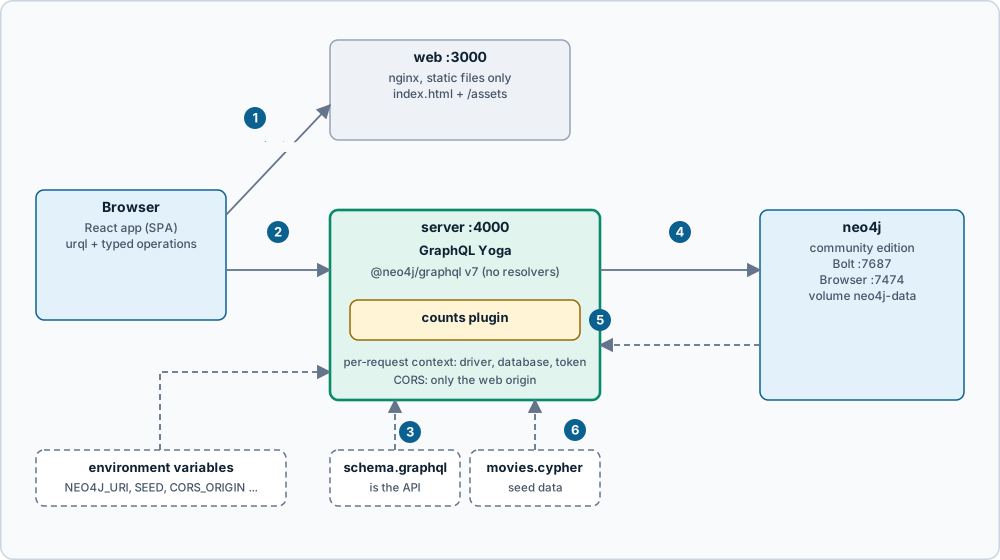
Figure: the default stack. The browser gets static files from one container and talks to the GraphQL server directly. Click the image for full size; the numbered notes below carry the same information as text.
- Static files only. The
webcontainer serves the built app with nginx (falling back toindex.htmlfor client-side routes). It never calls the server. - Direct GraphQL. The browser POSTs to
http://localhost:4000/graphql. That URL is fixed when the web image is built (VITE_GRAPHQL_URL), and the server’sCORS_ORIGINmust allow the web origin. - The schema file is the API.
schema/schema.graphqland the environment variables are read once at start. There are no resolvers to write. - Cypher over Bolt.
@neo4j/graphqltranslates each request into Cypher and runs it on the one database (neo4j; community edition has a single database). - Counts plugin. After every mutation the server recalculates the stored film counts on people, before it replies, so a refetch is correct.
- Seed on start. The Movies seed is loaded into an empty database, or reloaded when the seed file’s version is newer; data the server did not load is left alone.
- The browser loads the static app from
web(port 3000) and sends GraphQL requests directly toserver(port 4000).webdoes not proxy; the server allows the web origin with CORS. - The server has no resolvers. It reads
schema/schema.graphql, and@neo4j/graphqlgenerates the API and translates each request into Cypher. - Neo4j holds the data. Port 7474 serves Neo4j Browser (user
neo4j, password from.env).
| Repository | Role | Documentation |
|---|---|---|
grandstack (this one) | Compose stack, overview, tutorial, agent guide | here |
grandstack-server | The GraphQL server image | docs/ in that repo |
grandstack-web | The React app (open, no login) | docs/ in that repo |
grandstack-auth | Optional: gateway, Keycloak dev realm, auth rules, demo client | docs/ in that repo |
Data model (the sample)
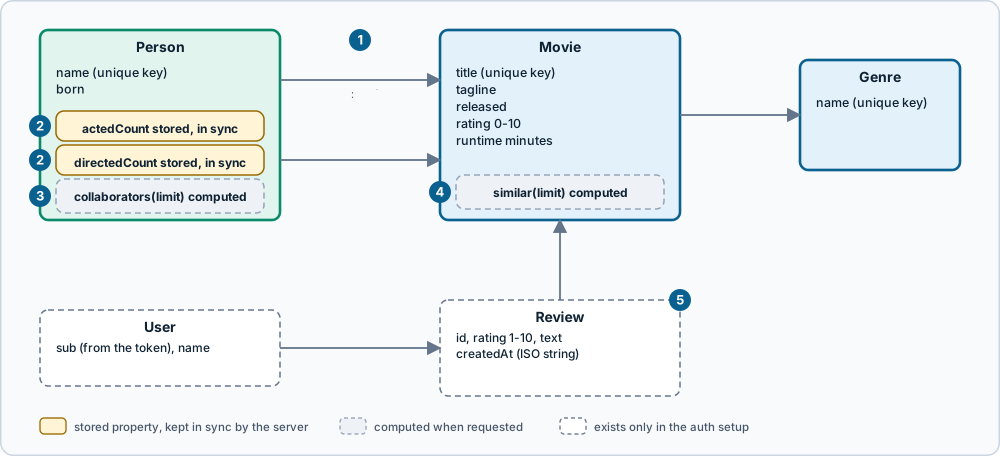
Figure: the sample data model. Dashed boxes exist only in the auth setup. Click the image for full size; the numbered notes below carry the same information as text.
- Roles live on the relationship.
ACTED_INcarries aroleslist as a relationship property. Titles and names are unique keys (constraints), so there are no ids. - Stored but derived.
actedCountanddirectedCountare real properties so people can be sorted and filtered in plain GraphQL; the counts plugin keeps them correct. - Computed on request.
Person.collaboratorsruns a Cypher traversal ranked by shared films and returns a name and a count. It cannot be sorted or filtered. - Computed on request.
Movie.similarscores films by shared director (3 points), cast (2) and genre (1). - Auth setup only.
ReviewandUsercome fromgrandstack-auth’s schema extension. A review’s author is taken from the token.
- Movie:
title(unique),tagline,released,rating(0 to 10),runtime(minutes). - Person:
name(unique),born, and the stored countsactedCountanddirectedCount. - Genre:
name(unique). ACTED_INcarries the character names asroles.- Computed fields in the schema:
Movie.similar(shared director, cast and genres) andPerson.collaborators(shared films). - 152 films, 464 people and 18 genres are bundled. The titles, casts and relationships are real; ratings and runtimes are approximate sample data.
The full field list is generated from the schema in grandstack-server/docs/schema-reference.md.
A request, end to end
Example: the user ticks the Drama genre on /movies.
- The React app updates the URL (
/movies?g=Drama). The URL is the single source of truth for filters. buildWhereturns the filters into a GraphQLMovieWhere, and urql sends the typedResultsoperation toPOST /graphql.- Yoga builds the request context (driver, database, options) and runs the operation.
@neo4j/graphqltranslates it to Cypher, runs it on Neo4j, and shapes the rows into the response, including genre and decade counts computed with the other filters applied.- The component renders typed data. If it was a mutation, a server plugin first recalculates the stored film counts, so the refetch is correct.
Authentication (opt-in)
The default stack above is open. Adding compose.auth.yaml puts a gateway in front of the server and adds Keycloak and a demo client:
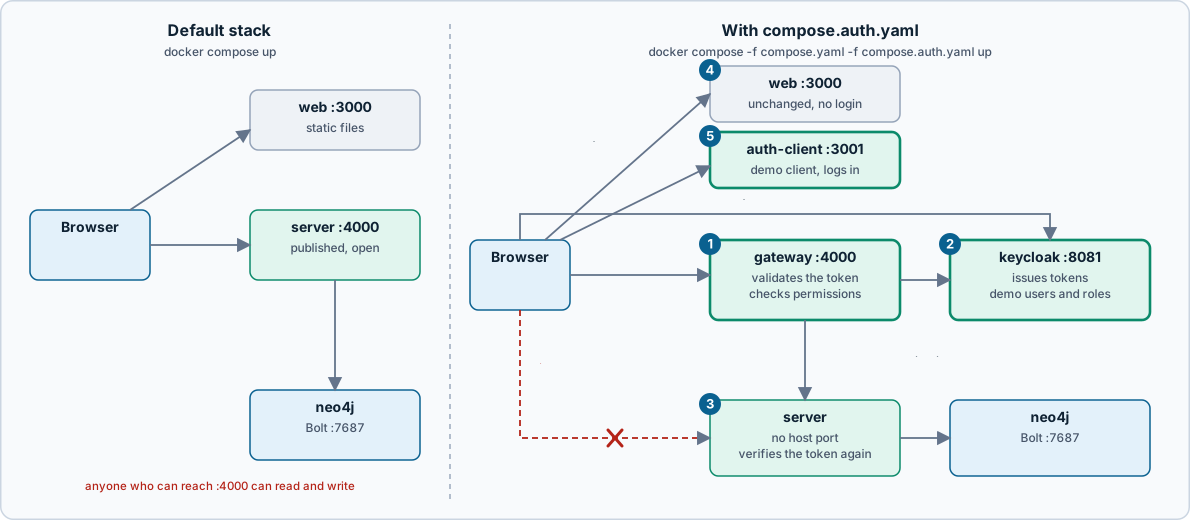
Figure: what compose.auth.yaml changes. New services are outlined in bold; the red dashed path is the one that disappears. Click the image for full size; the numbered notes below carry the same information as text.
- Gateway in front. It becomes the public GraphQL endpoint on port 4000, validates every token and checks permissions per mutation, then forwards the
Authorizationheader. - Keycloak beside it. It logs users in (OIDC code + PKCE) and signs tokens; the gateway and the server fetch its public keys (JWKS).
- Server no longer published. The browser can no longer reach it directly. It also verifies the token again and applies row-level rules.
grandstack-webunchanged. It still calls port 4000, which is now the gateway, so it acts as an anonymous client: reads work, writes are refused.- Demo client added.
auth-clienton port 3001 logs in and shows the rules at work.
- Reads are public; writes need a login. Roles
user,editor,moderatormap to permissions at the gateway and to row rules on the server (only a review’s author or a moderator can change it). - Two independent checks: the gateway answers “may this token call this mutation?”; the server answers “may it change this row?” and refuses unauthenticated writes even if reached directly.
- The server stays auth-agnostic: it only gets generic settings (
AUTH_*to verify tokens,SCHEMA_EXTRA_PATHSto load extra schema). TheUserandReviewtypes and every rule live ingrandstack-authand are mounted in. grandstack-webis deliberately unchanged. Through the gateway it is an anonymous client: reading works, writing is refused. Adding login to it is a documented exercise ingrandstack-auth.- Details, roles, responses and what to change for production: the
grandstack-authrepository’sdocs/how-it-works.md.
Agents (opt-in)
compose.agents.yaml adds one service, agents-mcp on port 4100: an MCP server that accepts GraphQL statements and runs them against the server. An agent can also skip MCP and send GraphQL itself; both paths share one guarded executor.
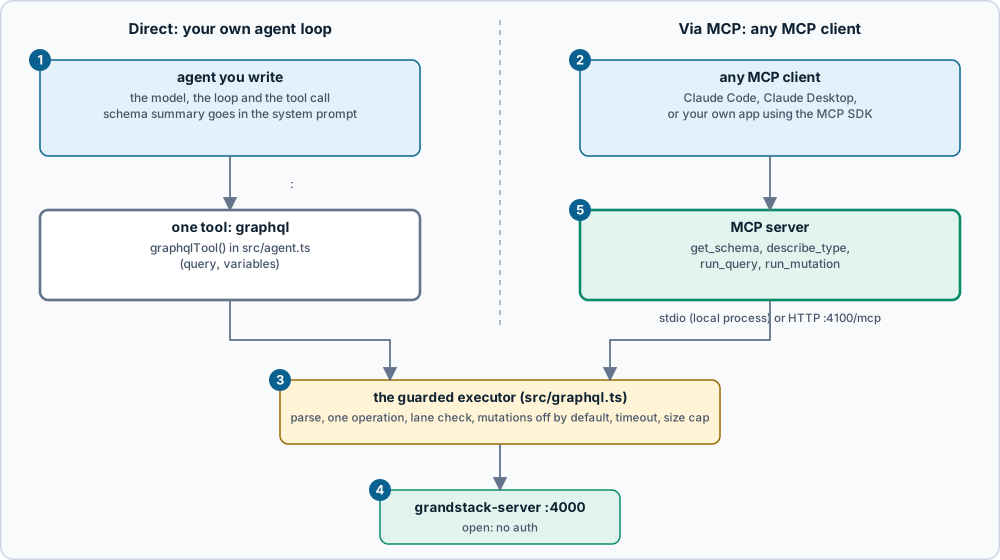
Figure: the two agent paths. Click the image for full size; the numbered notes carry the same information as text.
- An agent you write holds the model, the loop and one
graphqltool. - Any MCP client (Claude Code, Claude Desktop, your own app) lists and calls the tools.
- The guarded executor parses the statement, allows one operation, keeps queries and mutations apart, refuses mutations unless
ALLOW_MUTATIONS=true, and applies a timeout and a size cap. - The server is the open
grandstack-server; nothing about it changes. - The MCP server offers
get_schema,describe_type,run_queryandrun_mutationover stdio or HTTP.
- Read-only by default. That flag guards the MCP path only; the server on port 4000 stays open. Real control is auth:
grandstack-agents/docs/adding-auth.mdshows the same tools usinggrandstack-authwith a token. - The tools use introspection and know nothing about movies, so they work with another GraphQL server.
- Details: the
grandstack-agentsrepository’sdocs/how-it-works.md.
Federation (opt-in)
compose.federation.yaml turns the server into a federation subgraph, adds a Wikipedia subgraph, and puts a gateway on port 4000 that serves one combined API. The Neo4j subgraph moves to port 4001.
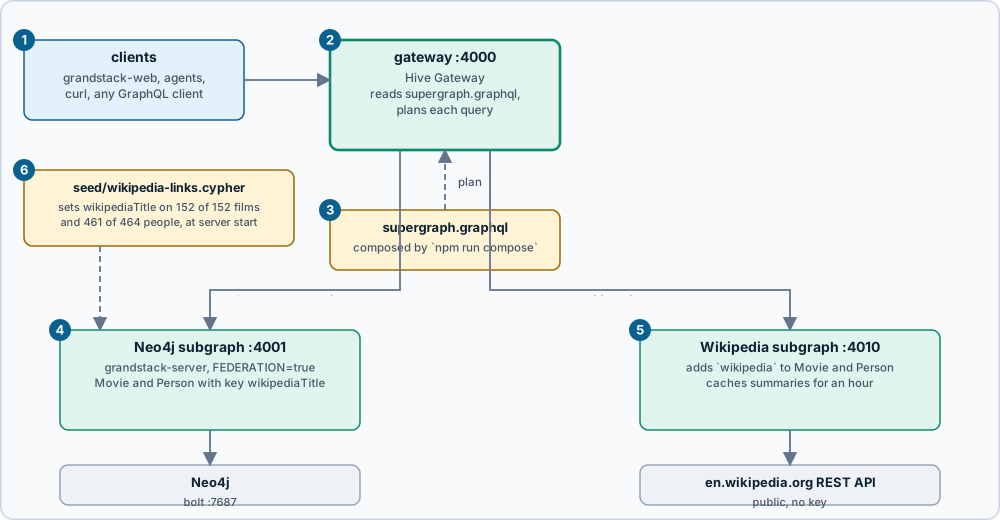
Figure: the federation setup. Click the image for full size; the numbered notes carry the same information as text.
- Clients (
grandstack-web, agents, curl) call one endpoint. - The gateway (Hive Gateway) reads the supergraph and plans each query.
- The supergraph is composed from the two subgraphs by
npm run composeand committed. - The Neo4j subgraph is
grandstack-serverwithFEDERATION=true; Movie and Person are keyed onwikipediaTitle. - The Wikipedia subgraph adds
wikipedia(description, extract, image, page link) to Movie and Person. - The links file gives films and people their Wikipedia page, set at server start.
- The Wikipedia part calls the live public Wikipedia API: it needs internet, is cached for an hour, and its text is CC BY-SA 4.0.
- A film or person with no link returns
wikipedia: nullwith no error; Wikipedia trouble returnsnullwith an error and the Neo4j fields still arrive. - Open, like the default stack: combining it with auth is not built.
- Details: the
grandstack-federationrepository’sdocs/how-it-works.md.
Design decisions and why
| Decision | Reason |
|---|---|
Generate the API from a schema file with @neo4j/graphql rather than writing resolvers | The schema is the single description of the API, which is easy for people and agents to read and change; filters, sorting and nested writes come for free. |
| GraphQL Yoga, no Apollo | The brief removes Apollo; Yoga is the Guild’s lightweight server with a plugin system we use. |
| Schema and seed are mounted files, configuration is environment variables | The same image serves any data model. See build your own app. |
| Seed has a version and a marker node; data it did not load is never touched | A newer seed reloads cleanly, and pointing the server at your own Neo4j never overwrites your data. |
Film counts stored on Person and refreshed by a plugin after every mutation | Computed (@cypher) fields cannot be sorted or filtered in plain GraphQL, and a plugin keeps every client (UI, curl, agent) correct without knowing about it. |
| Relationship edits are sent as diffs, never “disconnect all, then connect” | In @neo4j/graphql v7 the disconnect runs last and removes the new links. |
| Names and titles are the keys (unique constraints), so there are no ids | It keeps the sample readable and URLs meaningful; the cost is that renames change URLs and duplicates are rejected. |
| Filters live in the URL | Results are shareable and reloadable and the back button works. |
| Posters and avatars are generated from the text | No image licensing, no assets to host. |
Needle-style look reimplemented, @neo4j-ndl/* not used | Those packages are GPL-3.0 and this project is Apache-2.0. The tokens are approximations, not verified against Needle. |
react-force-graph-2d for graph views | MIT-licensed; Neo4j’s own NVL has a custom licence. |
| Separate repos, versioned with semver tags | Each piece can be cloned and used alone; the umbrella records which versions work together. |
Community Neo4j, database neo4j | It runs locally with no licence; community supports a single database. |
| Auth as a gateway plus server rules, in its own repo, opt-in | Authentication is orthogonal to the app: the gateway can front any GraphQL server, the server stays generic, the default quickstart stays zero-config, and grandstack-web shows what an app looks like before login. |
| Both the gateway and the server verify the token | Defence in depth: the server is safe even if reached directly. |
| Permissions at the gateway are derived from roles | Keycloak grants OAuth scopes per client, not per user, so roles are what differ between users; the gateway also accepts permissions and scope claims for other providers. |
Row-level filter rules, not validate; ISO strings, not DateTime | validate rules and DateTime reads need Neo4j’s APOC plugin, which this stack does not include. |
Reviews are created by a custom mutation using the token’s sub | The author cannot be spoofed because clients cannot pass one; the generated create is removed. |
Limits today
- The default stack has no authentication. Anyone who can reach the server can read, create, edit and delete everything. Do not expose it publicly. The opt-in auth setup is development-only too (Keycloak dev mode, demo users, plain HTTP); see
grandstack-authfor what production would need. - The compose file builds the server and web images from sibling checkouts; it does not pull published images yet (versioning).
- Everything runs on one machine in Docker or Podman; there is no production deployment recipe.
Source: grandstack/docs/architecture.md (this page is a copy; edit it in the repository)