docs / grandstack-federation / Concepts
How it works
The pieces
| Where | What |
|---|---|
grandstack-server with FEDERATION=true | The Neo4j subgraph. Same schema and data as before, served with getSubgraphSchema() so it also answers _service and _entities |
schema/federation.graphql | Extra schema for that server: the federation @link, @key on Movie and Person, and the wikipediaTitle and wikidataId fields |
seed/wikipedia-links.cypher | Generated links, run at every server start |
wikipedia/ | The Wikipedia subgraph: adds wikipedia to Movie and Person |
gateway/ | The composed supergraph.graphql, mesh.config.ts that makes it, and the gateway’s config and Dockerfile |
scripts/ | resolve-links.ts (builds the links), matching.ts (the matching rules), smoke.ts |
The stack
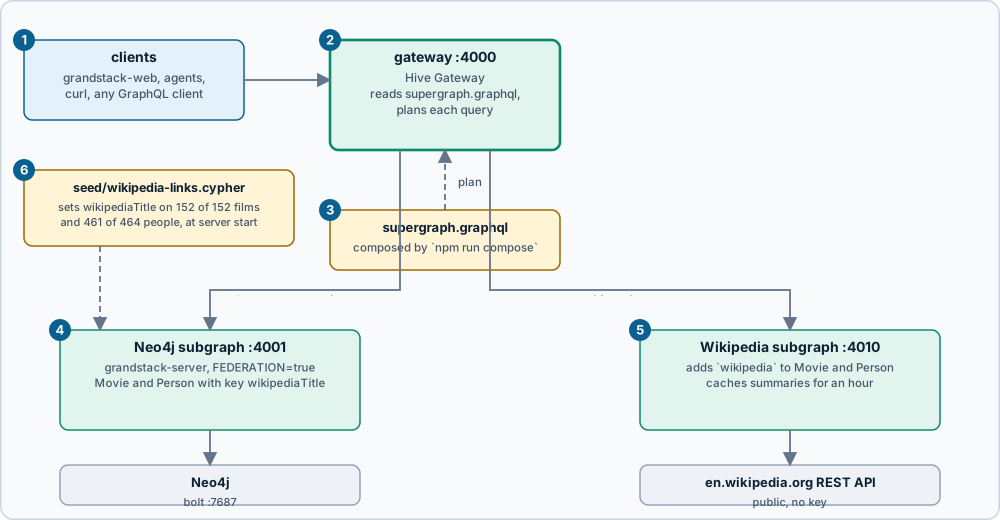
- Clients call one endpoint and need to know nothing about subgraphs.
- The gateway reads the supergraph, splits each query into parts for the subgraphs, and merges the answers.
- The supergraph is a file describing both subgraphs’ schemas and which subgraph owns which field.
- The Neo4j subgraph owns Movie and Person. Both are entities with the key
wikipediaTitle. - The Wikipedia subgraph extends the same two types by key, adding one field to each.
- The links file gives nodes their key.
One query, step by step
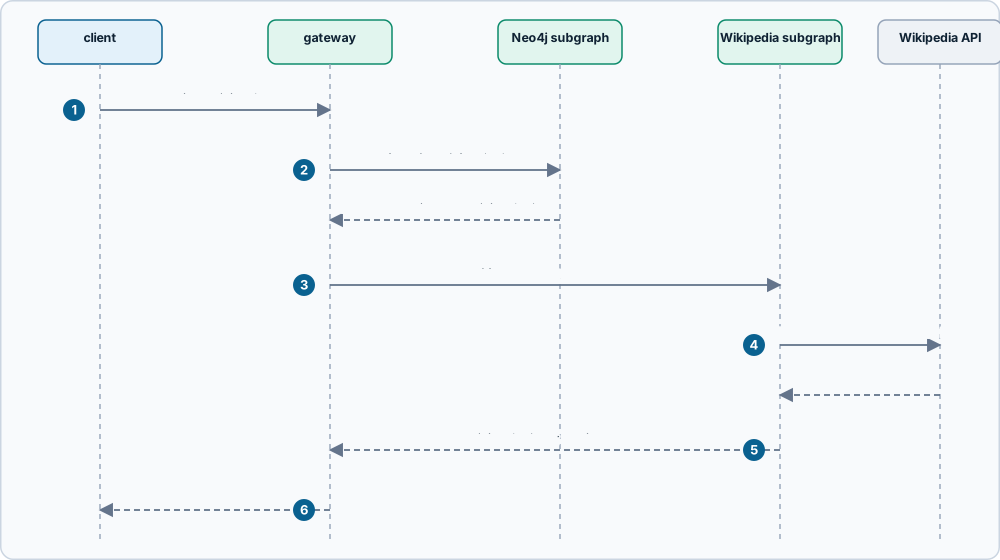
- The client sends
{ movies { wikipedia } }-style queries to the gateway. - The gateway asks the Neo4j subgraph for the movies and their
wikipediaTitle. - It sends only the rows that have a key to the Wikipedia subgraph as entity representations (
_entities). A film with no link is skipped, so itswikipediais simplynull. - The Wikipedia subgraph answers from its in-memory cache (one hour), or calls Wikipedia’s summary endpoint.
- It returns the fields, or
nullwhen Wikipedia has no such page. - The gateway returns one merged result.
A page that does not exist is just null. If Wikipedia is slow, rate limiting or unreachable, the Wikipedia subgraph answers with a GraphQL error (code WIKIPEDIA_UNAVAILABLE, checked directly against the subgraph), and the field is null. If the Wikipedia subgraph itself is down, the gateway returns wikipedia: null with the error Unexpected error. (checked by stopping the container). In both cases the Neo4j fields are still returned.
What federation changes for what you already have
- The data model, the seed and the default stack are unchanged. Federation is opt-in (
compose.federation.yaml). grandstack-webis unchanged: it calls port 4000, which is now the gateway. Its 78-check browser run passes through the gateway.- The Neo4j subgraph moves to port 4001 so the gateway can have 4000.
- The supergraph exposes everything the server did, plus
wikipedia,wikipediaTitle,wikidataIdandWikipediaSummary.
Auth and agents
- Auth is not combined here. This stack is open, like the default one. Putting
grandstack-authin front of a federated graph is a separate task: the gateway would validate tokens and forward theAuthorizationheader to the subgraphs. That is not built or tested. - Agents see both subgraphs. Point
grandstack-agentsat the gateway (GRAPHQL_URL=http://localhost:4000/graphql) and its tools work unchanged:get_schemanow includesWikipediaSummaryand thewikipediafields (the summary grew from about 4.6 KB to about 6.4 KB), andrun_queryreturned the Wikipedia description for Heat in a check. Describe cross-subgraph fields well: an agent can only use what the descriptions tell it, and a field that says “null when not linked” saves it a wrong guess.
Source: grandstack-federation/docs/how-it-works.md (this page is a copy; edit it in the repository)