grandstack-agents: overview
How agents work with GraphQL. Two ways, both against the open grandstack-server:
- Directly: the agent sends GraphQL queries and mutations itself, through a single
graphqltool in its own loop. - Through an MCP server: a small server that accepts GraphQL statements and runs them. Any MCP client (Claude Code, Claude Desktop, your own app) can use it.
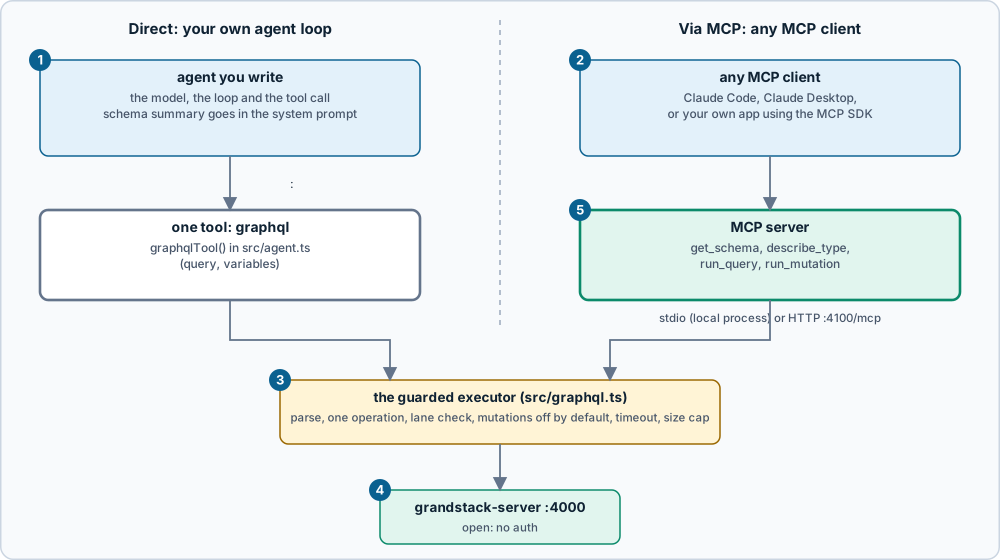
- An agent you write: the model, the loop and one
graphqltool. - Any MCP client: Claude Code, Claude Desktop or your own app.
- The guarded executor both paths share: parse, one operation, lane check, mutations off by default, timeout, size cap.
grandstack-server, open, no auth.- The MCP server with its four tools, over stdio or HTTP.
No login is needed here: it talks to grandstack-server as it is. Adding auth shows how to point the same tools at the grandstack-auth gateway, with example code. Agent memory, where auth becomes part of the design, is a later phase and its own repo.
Read-only by default.
run_mutationdoes nothing until you start the server withALLOW_MUTATIONS=true. That flag is a guardrail for the MCP path, not access control: the server on port 4000 is open. See guardrails.
The tools
| Tool | Does |
|---|---|
get_schema | A compact summary of the API (root fields, the types the schema defines). detail: "full" returns everything. |
describe_type | One type or input in full, for example MovieWhere, so an agent learns exact shapes step by step. |
run_query | Runs a query. Mutations are refused. |
run_mutation | Runs a mutation, only when ALLOW_MUTATIONS=true. |
Run it
With the grandstack umbrella and its sibling repos cloned side by side into one folder:
mkdir grand-stack && cd grand-stack      # any folder name
for repo in grandstack grandstack-server grandstack-web grandstack-agents; do git clone https://github.com/grand-stack/$repo; done
cd grandstack
docker compose -f compose.yaml -f compose.agents.yaml up --build
The MCP server (streamable HTTP) is then at http://localhost:4100/mcp. Or run it from a clone of this repo (Node 22 or later) against a stack that is already up:
git clone https://github.com/grand-stack/grandstack-agents   # skip if you cloned it above
cd grandstack-agents
npm ci
npm run mcp:http        # HTTP on :4100
npm run mcp:stdio       # stdio, for clients that start the process themselves
Connect Claude Code:
claude mcp add --transport http grandstack http://localhost:4100/mcp
More clients and setups are in the MCP server guide.
Documentation
| Read | To learn |
|---|---|
| How it works | The pieces, a tool call end to end, the diagrams |
| The MCP server | Tools in detail, transports, client setup, debugging with curl, configuration |
| Direct GraphQL | What an agent does without MCP, with copy-paste examples |
| The agent loop | The runnable example, the model adapter, running it with Claude |
| Adding auth | Using grandstack-auth with these tools, with verified example code |
| Schema design for agents | Why tailored type definitions beat introspection alone, and what to do if you cannot change them |
| Guardrails | What is checked, what is not |
| Recipes | Add a tool, restrict operations, change limits |
| Testing | Unit, MCP, live and container checks |
| Troubleshooting | Errors and their fixes |
Working with a coding agent? Start with AGENTS.md.
Last verified: grandstack-agents v0.1.2 with grandstack-server v0.7.1 and grandstack-auth v0.1.1, @modelcontextprotocol/sdk 1.32.1, Node 24, under Podman 6 on macOS. The live Claude run of the agent example needs an ANTHROPIC_API_KEY and has not been run by the authors; the loop is tested with a scripted model.
Licence
Apache License 2.0. See LICENSE and NOTICE. The same licence applies to every GRANDstack repository and to grandstack.ai.
Source: grandstack-agents/README.md (this page is a copy; edit it in the repository)